Blog 2
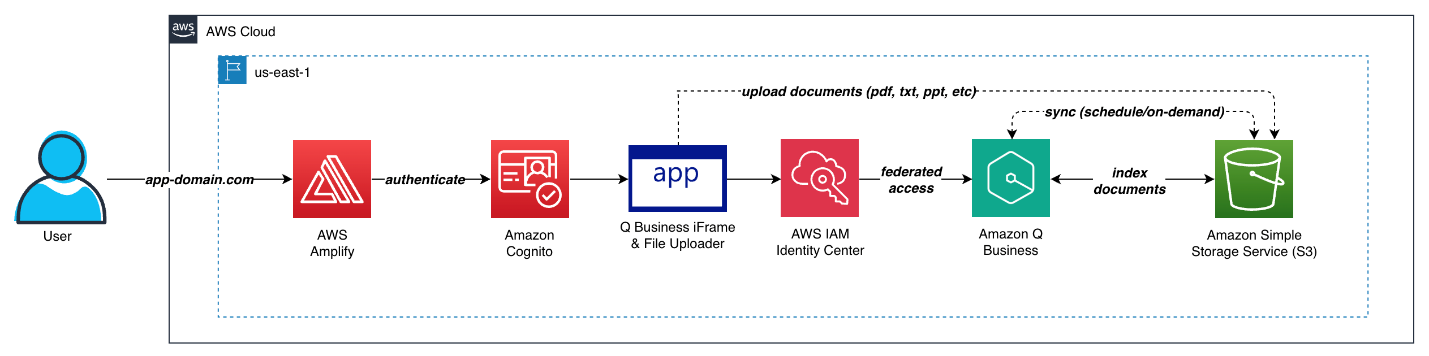
The second blog I translated focused on a growing enterprise need: letting users ask natural-language questions over internal documents instead of manually searching through files and folders. AWS presented a solution built with Amazon Q Business, AWS Amplify Gen 2, and AWS CDK to support this kind of intelligent internal knowledge access with controlled permissions.
This article was especially interesting to me because it relates directly to knowledge discovery from documents, which is also a promising future direction for CloudDoc.
1. Solution overview
The architecture in the blog uses:
- Amazon Q Business to provide question-answering over internal knowledge sources.
- AWS Amplify Gen 2 to build and deploy the application.
- AWS CDK to manage infrastructure as code.
- Amazon Cognito and IAM Identity Center for authentication and access control.
- Amazon S3 to store the internal documents used for indexing.
One strong point of this approach is that the organization does not need to build the entire AI platform from scratch. Instead, it can use managed AWS services and focus on the actual business workflow.
2. How the architecture works
The main flow can be summarized as:
- Users sign in through Cognito.
- Internal documents are stored in Amazon S3.
- Amazon Q Business is granted permission to access and index that content.
- A chat interface is embedded directly into the web application.
- Users ask questions and receive answers grounded in the indexed enterprise data, with references.
From a product perspective, this is important because it turns a passive document repository into a more interactive knowledge system.
3. Main highlights from the blog
Three points stood out most clearly to me:
- Infrastructure is managed with AWS CDK, which reduces manual setup and improves repeatability.
- The AI layer is grounded in real internal data, not just generic conversation.
- Access control is treated seriously, which is critical whenever enterprise knowledge is involved.
4. What I learned from this blog
After translating this article, I understood more clearly that the value of AI in an application does not come only from text generation. It also depends on how well the underlying data is organized so the AI can respond with the right context. This strongly connects to CloudDoc, because future AI features would only work well if document metadata, storage structure, and permissions are already designed properly.
5. Connection to CloudDoc
- If CloudDoc grows further, Amazon Q Business or a similar document-based assistant could become a suitable future extension.
- Document metadata and categorization in CloudDoc are the foundation for any future AI-assisted discovery feature.
- Combining application workflows with internal knowledge access is a very relevant direction for a smart learning-resource platform.
6. Conclusion
Embedding AI assistants into internal applications is becoming increasingly common across organizations. The architecture based on Amazon Q Business, Amplify, and CDK is a strong reference pattern for systems that need to extract value from document knowledge in a secure and scalable way.
FCAJ group post link: https://www.facebook.com/share/p/1BkgmtmwUw/